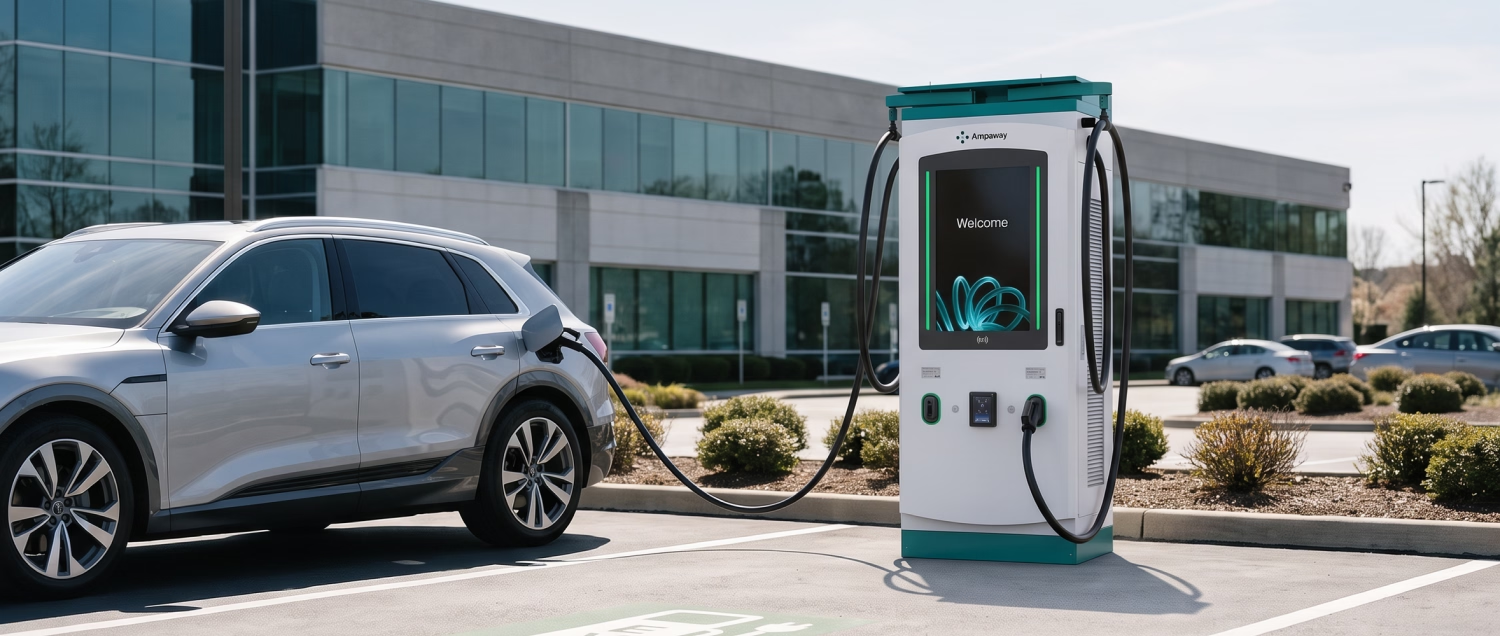

Only about 5 percent of multifamily buildings currently offer EV charging, yet residents ask for it more than almost any other amenity upgrade. That gap is pushing owners and managers to move faster than planned, often right after a tenant asks directly why the building doesn't have it yet.
Installing chargers at an apartment property comes down to three sets of decisions: how much electrical capacity the building has, who manages billing and day-to-day access, and who owns the equipment and pays for it. This guide walks through each one in order, covering how to assess capacity, choose hardware, structure payment, and install an EV charger at an apartment property without over- or under-building for demand.
Why apartments need EV charging
Several separate forces are converging on the same decision at once: resident demand, competitive positioning against other properties, and portfolio-level sustainability targets. For most owners, at least one of these is already showing up as pressure, whether through a tenant request, a competitor's listing, or a corporate sustainability report. The same pressure shows up across EV charging for multifamily properties generally, since condos and HOAs face similar resident requests.
Growing EV adoption among residents
EV ownership among renters and condo residents keeps climbing, and most EV owners prefer charging overnight at home rather than relying on public stations after work. For many apartment hunters, the question surfaces early in the search: can I install an EV charger at my apartment? A property that can't answer yes on the spot loses that lease to a building down the street that can.
Increasing property value and competitiveness
EV charging also shapes who stays and who leaves. Residents with a charger tied to their parking space rarely give it up voluntarily, since moving usually means losing that setup and starting over somewhere else. EV drivers also skew toward higher income brackets, giving owners a concrete case for treating charging as a tool for attracting a more stable, lower-risk tenant base.
Supporting long-term sustainability goals
Sustainability commitments are also pushing this up the priority list, particularly for developers and institutional owners who report on environmental performance across their portfolios. EV charging counts toward green building certifications and investor sustainability benchmarks, giving those portfolios a measurable data point tied to financing and reporting requirements they already have to meet.
Understand your property's charging needs
Before evaluating hardware or electrical capacity, owners need a clear picture of how the property functions today: who has access to parking, how it's assigned, and how many residents are likely to need a charger in the next few years.
Resident-only vs. shared charging
Some properties reserve charging strictly for residents, treating it as a building amenity tied to a lease. Others open a portion of chargers to visitors, staff, or the surrounding neighborhood, generating session revenue from people who aren't paying rent there at all. That choice affects how many chargers a property needs, since a resident-only setup can run on a tighter schedule than one that also serves drop-in traffic during the day.
Assigned vs. unassigned parking spaces
Parking structure changes what's even possible to install. Buildings with assigned spaces can wire a charger directly to a specific unit's spot, which simplifies both EV charger installation and billing since usage ties back to one resident. Properties with unassigned or first-come parking don't have that option, so chargers need to work as shared resources instead, which raises different questions about queuing and fair access covered later in this guide.
Estimating future charging demand
The safest way to estimate demand starts with the residents already on the property: how many currently own or lease an EV, and how many have mentioned interest in one at renewal time. That number, combined with regional EV adoption trends and typical lease turnover, gives a rough sense of how many chargers to install in year one versus how many spaces to simply prepare for down the line. Guessing too high ties up capital in unused equipment, and guessing too low means residents competing for a handful of chargers within the first year.

Evaluate your electrical capacity
What the property can support today, and how far that capacity can stretch with the right approach, determines almost everything else in this guide.
Existing electrical infrastructure
Every property has a fixed amount of electrical capacity coming in from the utility, and most of it is already committed to lighting, HVAC, elevators, and individual units. A site assessment identifies how much of that capacity sits unused and where it's located relative to parking, since running power a short distance costs far less than routing it across an entire structure. Skipping this step and guessing at capacity produces numbers that rarely survive contact with an actual quote. A proper assessment also flags the EV charger installation requirements, like permits and inspections, that affect how long the project takes before any hardware goes in.
When upgrades are necessary
Upgrades become necessary when the gap between available capacity and what a project needs is too large to close through smarter power management alone. This shows up most often in older buildings with limited spare capacity, or in projects that call for high-power DC charging, which demands far more from the electrical system than slower, overnight charging does. In most other cases, the capacity a building already has can support more chargers than it first appears to, without a utility upgrade or panel replacement.
Using dynamic load management to avoid costly upgrades
Dynamic load management treats a building's total available power as a shared pool rather than dividing it into fixed allotments per charger. Instead of reserving a charger's full rated power at all times, the system shifts power in real time based on which vehicles are actually plugged in and how much they need at that moment. When a new driver plugs in after the building hits its power limit, the system reduces output slightly across the other active sessions rather than blocking the new one out.
The difference in charger count this makes is substantial. A building with 400 amps of capacity might only support 10 chargers rated at 40 amps each if each charger's full output has to be reserved permanently. With load management redistributing power across active sessions instead, that same 400 amps can support up to 50 chargers, since it's rare for every charger to draw its maximum at the same time. That's the difference between a modest pilot program and charging access across the entire property, without touching the panel or the utility connection at all.
Choose the right EV chargers
Hardware decisions come down to matching EV charger type to how residents park and charge on this specific property.
AC vs. DC charging for apartments
Most apartment charging should be AC (Level 2). Residents park overnight for eight hours or more, so a charger that fully replenishes a battery in that window is enough, and it costs a fraction of DC hardware to install and run. DC fast charging is built for quick turnover, which apartment parking rarely needs.
Wall-mounted vs. pedestal chargers
Wall-mounted chargers work well where parking sits against a garage wall or structural column, keeping installation simple and the equipment out of the way. Pedestal units make more sense for mid-row or open-lot spaces with no adjacent wall. The choice comes down to parking layout, since both formats deliver the same charging capability.
OCPP-compatible chargers
OCPP is the open communication standard that most charging networks use to communicate with management software. Choosing OCPP-compatible hardware keeps a property from being locked into one software provider for the life of the equipment, since software needs change faster than the hardware itself.
Ampaway chargers are fully certified for OCPP 1.6 and OCPP 2.0.1, meeting the industry’s highest standards for interoperability, security, and future-proofing.
Decide who pays for charging
How a property pays for charging affects who adopts it fastest and how quickly the investment pays for itself. Most properties land in one of three payment structures, or blend elements of each depending on lease type and resident mix.
Resident-paid charging
Under a resident-paid model, EV drivers cover the cost of every session, either through pay-per-use pricing or a flat monthly subscription tied to charging access. This keeps electricity costs off the property's books and shifts them onto the residents using the equipment, which many owners prefer since it avoids subsidizing a benefit only some tenants use.
Property owner-funded charging
In an owner-funded model, charging is folded into rent or HOA dues as a standard building amenity, similar to trash pickup or pool access. Residents don't see a separate charge for plugging in, which simplifies the experience but means the property absorbs the electricity cost across every unit, whether or not a given resident drives electric.
Mixed payment models
Mixed models combine the two, often by including a baseline amount of charging in rent and billing residents only for usage beyond that threshold. Some properties instead offer free charging during off-peak hours and standard rates during peak demand, which spreads usage more evenly across the day. These structures mirror the broader EV charging business models property owners use across commercial and residential sites, each with different tradeoffs in cost, control, and revenue.
Setting charging prices
Pricing usually starts from the property's electricity cost per kilowatt-hour, plus a margin to cover equipment, maintenance, and management overhead. Per kWh pricing is more accurate, while per hour pricing is simpler to bill but less precise for residents who charge briefly. It's also worth checking rates at nearby public stations, since pricing far above or below that range changes how residents perceive the benefit.
Simplify management with charging software
Software is what turns the earlier decisions on access, pricing, and hardware into a working system residents actually use. Ampaway's EV charging management software, for example, combines authentication, billing, monitoring, and reporting into a single dashboard instead of requiring separate tools for each function.
For best results, the charging software should be OCPP 1.6 and OCPP 2.0.1 certified; Ampaway already meets these requirements.
User authentication
Authentication controls who can start a session, typically through a mobile app, RFID card, or QR code scan at the charger itself. For resident-only properties, this ties each session back to a specific unit or lease, which matters for both billing and for preventing outside drivers from using resident chargers.
Billing and payment processing
Billing software executes whatever payment model a property has chosen, whether that means charging residents per session, invoicing a flat subscription, or metering usage against a rent-included baseline. This needs to run automatically, since manual invoicing for dozens of residents charging on different schedules doesn't scale past a handful of chargers.
Remote monitoring and maintenance
Remote monitoring gives property managers visibility into charger status without needing to physically check the parking garage. Alerts flag a charger that's gone offline or is drawing power incorrectly, often before a resident notices and files a complaint, which shortens the time a charger sits broken.
Usage reporting and analytics
Usage data shows which chargers get used most, at what times, and by how many unique residents, which feeds directly back into the demand estimates made earlier in the planning process. It also gives owners the numbers needed to evaluate whether pricing or access rules need adjusting after the first few months of real usage.
Plan for future expansion
Planning for growth costs far less during the initial installation than it does later, once walls are closed up and parking is back in daily use. A few relatively inexpensive choices upfront can save a much larger expense down the line.
Installing conduit for additional chargers
Running conduit to every future charging space during the first phase of installation costs relatively little, since the labor and disruption of opening walls or trenching pavement has already happened. Leaving that conduit empty and capped means adding a charger later is mostly a matter of pulling wire and mounting the unit, rather than repeating the disruptive part of the job from scratch.
Scaling without replacing infrastructure
The load management approach covered earlier in this guide does the rest of the work here. Since it lets a fixed amount of electrical capacity support a growing number of chargers, properties can add units over time without a second electrical upgrade, as long as the conduit and panel space were planned for at the start.
Preparing for higher resident demand
Demand estimates made early in the planning process are a starting point, not a fixed number. Lease turnover, new construction nearby, and shifting EV adoption rates all move that number over time, usually upward. Reviewing usage data every year or two, rather than assuming the original estimate still holds, keeps a property from falling behind resident expectations again.

Common apartment EV charging challenges
Even a well-planned charging project runs into friction after installation. Most of these issues trace back to decisions made earlier in the process, and understanding them ahead of time makes them easier to avoid.
Limited electrical capacity
A property that skips the capacity assessment covered earlier in this guide often finds out the hard way, usually when a fourth or fifth charger can't be added without a costly panel upgrade. Load management resolves most of this before it becomes a problem, but only if it's built into the system from the start rather than added as an afterthought once capacity is already maxed out.
Parking allocation
Assigned parking limits chargers to specific units, which can leave EV-driving residents without a spot near a charger if their assigned space happens to be far from the electrical panel. Unassigned parking avoids that mismatch but introduces its own problem, since any resident can occupy a charging space whether or not they're actually charging.
Managing shared charger access
Shared chargers create a different kind of conflict: a resident who finishes charging but leaves the car parked in the spot for hours blocks everyone else from using it. Properties that rely on shared access typically need some combination of time limits, notifications when charging completes, and a clear policy for what happens when someone doesn't move their car.
Ongoing maintenance responsibilities
A charger that goes down and stays down for weeks does more damage to resident trust than not having one at all. Someone needs to own responsibility for diagnosing issues, ordering parts, and dispatching a technician, and properties without a clear answer to that question end up with dead equipment sitting in the parking garage. This is usually the point where owners start weighing whether to manage service in-house or hand it off to a provider that takes on that responsibility directly.
Best practices for a successful apartment EV charging project
There's no single formula for how to install an EV charger at an apartment complex, but a handful of principles hold up across almost every property, regardless of size or budget.
Start with a site assessment
Every decision in this guide traces back to an honest look at what the property has: parking layout, electrical capacity, and how many residents are likely to need a charger. Projects that skip this step either overbuild capacity they don't need or underbuild into a wall they hit within a year.
Choose scalable hardware and software
Hardware and software chosen for scale, OCPP-compatible chargers, conduit run to future spaces, and a management platform that can add chargers without a system overhaul costs a little more upfront and saves considerably more later. The properties that end up retrofitting or replacing equipment within a few years are usually the ones that bought only for what was needed on day one.
Communicate with residents early
Letting residents know a charging project is coming, and asking what they'd want from it, heads off a lot of the conflict that shows up later around parking and access. A short survey before installation can also sharpen the demand estimate, since it replaces a guess with real numbers from the people who'll use the chargers.
Plan beyond today's demand
The number of chargers a property needs today is rarely the number it needs in three years. Building in room to grow, through conduit, panel space, and load management, costs far less than treating the first phase as the only phase.
Building an apartment EV charging solution that grows with your property
Getting apartment EV charging right comes down to the order of decisions covered in this guide: assess what the property already has, evaluate real electrical capacity before assuming an upgrade is needed, choose hardware that fits how residents park, and land on a payment model before picking software to run it. None of these steps matter much on their own. What holds a project together over time is scalable infrastructure, load management that stretches existing electrical capacity, and access residents can use without friction.
Ampaway handles apartment EV charging end to end, providing the hardware, installation, and software needed to manage, monitor, and monetize the equipment, while taking on the maintenance and support owners would otherwise have to staff themselves. That's the core of our EV charging solution for apartments: owners add a revenue-generating amenity without carrying the operational risk that usually comes with it.