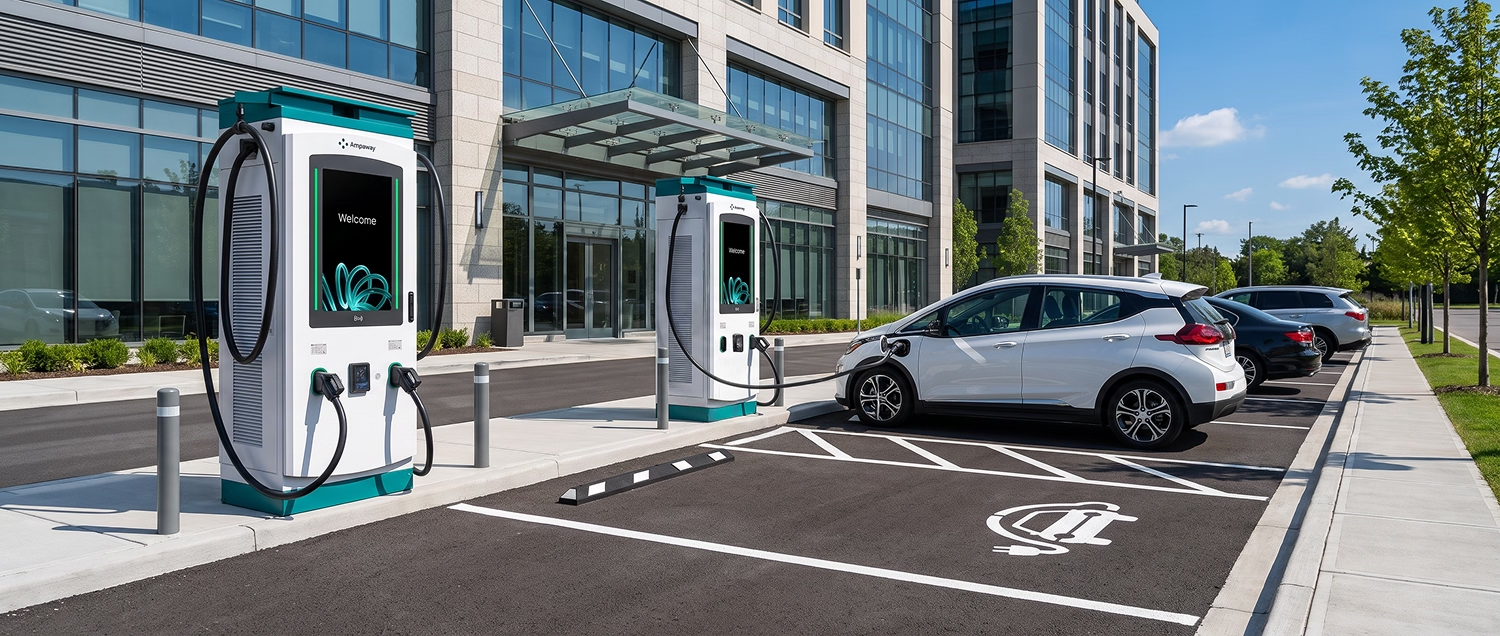

If you've searched for commercial EV charging station installation costs recently, you've probably seen estimates ranging from a few thousand dollars to several hundred thousands, with little explanation of what actually causes that spread. The number depends on several factors specific to your property, and understanding each one is what turns a vague estimate into a working budget. This breakdown covers the real cost drivers, what to expect at different property sizes, and where the numbers tend to surprise people.
What you’re actually paying for
When people talk about the cost to install a commercial EV charging station, they're often referring to different things without realizing it. Some figures cover hardware only. Others fold in installation. Very few include everything a property owner actually needs to budget for.
A complete project has five cost areas. Hardware is the charger unit itself. Installation labor is the physical work of mounting, wiring, and connecting each unit. Electrical infrastructure covers any upgrades your building needs before it can support the load. Permitting and inspections are a standard part of any commercial electrical project. And software or network fees are the recurring costs of running the system once it's installed.
Hardware costs by charger type
Commercial properties generally work with two charger types: Level 2 and DC fast chargers.
Level 2 is the standard choice for multifamily buildings, workplaces, hotels, and retail centers. Hardware runs $1,000 to $2,000 per port, with the variation coming down to three things: power output, whether the unit has built-in network connectivity for billing and access control, and brand tier.
DC fast chargers deliver 150kW to 400 kW per unit and make sense where drivers need to charge in under 30 minutes instead of over several hours. Hardware costs between $30,000 and $100,000 per unit for standard commercial configurations, with higher-power units pushing beyond that.
For most properties, Level 2 is the go-to starting point. DC fast charging becomes relevant when your site sees high turnover or short average dwell times. Evaluating the best commercial EV charging solutions means looking at total cost of ownership across both types, not hardware price alone.
Installation and electrical work
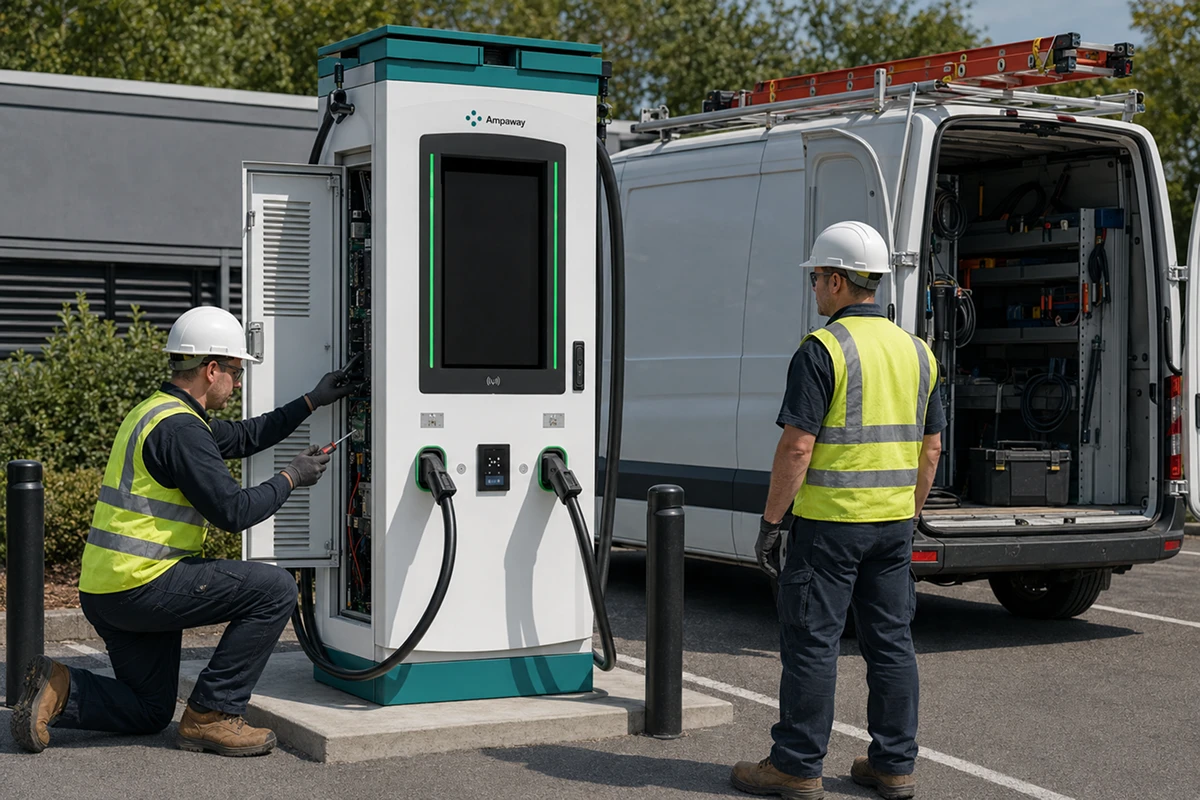
For most properties, EV charger installation labor runs $1,000 to $3,000 per port when the electrical system can already support the load. The cost to install a commercial EV charging station changes depending on what your building is starting with.
The two most common cost triggers are panel upgrades and trenching. If your existing capacity isn't enough, a panel upgrade typically adds $10,000 to $60,000 to the project. Trenching and conduit work, which comes into play when chargers are installed far from the main service panel, runs roughly $50 to $150 per linear foot and can add up fast on larger lots.
That said, electrical infrastructure costs are more manageable than they first appear. Dynamic load balancing distributes available power across all active chargers in real time, which means a building can support significantly more chargers without increasing its electrical capacity. A property with a 400-amp service that would ordinarily support 10 chargers can often support 40 to 50 with load balancing in place, eliminating the need for a panel upgrade entirely.
Permits, inspections, and other line items
These costs rarely make it into the first estimate, but they belong in any serious budget from the start.
Permitting and inspection fees vary by jurisdiction but typically run $500 to $4,000 for a commercial installation. Projects that require utility coordination, such as those involving a service upgrade or new utility connection, can add several thousand dollars more and extend the project timeline.
Ongoing software and network fees are the other line item that catches people off guard. Most networked commercial chargers require a subscription to manage billing, access control, and monitoring. Expect to budget $150 to $300 per port per year, depending on the platform and feature set. A note on EV charging management software: pricing and capabilities vary considerably across providers, so it's worth evaluating this alongside hardware rather than as an afterthought.
Incentives that can reduce your costs
The federal 30C Alternative Fuel Vehicle Refueling Property Credit has been one of the more significant cost offsets available to commercial property owners, covering up to 30% of eligible project costs, capped at $100,000 per port. The credit is currently set to expire on June 30, 2026, so if your project is already underway, now is the time to confirm eligibility with a tax advisor.
For California properties, CALeVIP offers substantial incentives for publicly available EV chargers and remains active. New project windows are opening in October 2026 and February 2027, with incentives covering up to 100% of eligible installation costs for DC fast chargers. The program is administered through the California Energy Commission and is worth checking early in your planning process since funding windows open and close on fixed schedules.
Beyond these two, most states and many utilities run their own rebate programs. The amounts and eligibility requirements vary, and some programs are tied to specific census tracts or income designations. Checking what's available in your area before finalizing a project scope can change the net cost of a commercial EV charging station considerably.

What the total actually looks like
With the individual cost categories in place, here is what a complete project budget typically looks like across two common scenarios. These are planning estimates based on current market data, but your actual number will depend on your building's electrical setup, location, and the provider you work with.
Small Level 2 installation (3 to 5 ports)
This is the most common starting point for multifamily buildings and smaller workplaces. Hardware runs $3,000 to $10,000 for the ports. Installation labor and basic electrical work adds $1,000 to $3,000. Permitting and inspections bring in another $500 to $3,000. Software fees run $450 to $1,500 per year ongoing.
Total estimated range before incentives: $8,000 to $30,000.
Larger multi-port setup (15 to 20 ports)
More typical for retail centers, larger multifamily properties, or commercial parking facilities. Hardware runs $15,000 to $40,000. Installation and electrical work, including any panel upgrades or trenching, adds $20,000 to $50,000. Permitting and inspections add $1,500 to $5,000. Software fees run $2,250 to $6,000 per year ongoing.
Total estimated range before incentives: $40,000 to $110,000.
The spread within each range comes down primarily to two variables: how much electrical infrastructure work your property needs, and whether load balancing allows you to avoid a panel upgrade. These two factors move the number more than hardware selection does.
An alternative worth knowing about
Not every property owner wants to take on the capital costs mentioned above, and there is a model built around that.
Some providers cover hardware, installation, and ongoing service costs in full, in exchange for a share of the revenue generated by the chargers. The property owner pays nothing upfront and takes no responsibility for maintenance or repairs. In return, they receive a portion of charging revenue rather than keeping it entirely.
It’s important to evaluate this structure alongside the ownership model, particularly for properties where capital budgets are tight or where taking on operational responsibility for a new system isn't practical. The tradeoff is simple: lower financial risk in exchange for a share of the long-term revenue.
Ampaway offers commercial EV charging solutions on this model, covering the full project cost and ongoing service with no subcontractors involved and no ongoing software subscription fee, while property owners earn from the chargers from day one.
The number that matters most
After applicable incentives, the net cost of a commercial EV charging project often looks meaningfully different from the headline figure. A well-timed project that qualifies for federal and state programs can recover 30% or more of total costs before the chargers have processed a single session.
From there, the chargers generate ongoing revenue. For property owners on a revenue-share model, that starts from day one with no capital outlay. For those who own the hardware outright, the revenue accumulates against the initial investment over time. Either way, the financial case improves the longer the chargers are in operation.
There is also the indirect return to account for. Properties with EV charging tend to attract tenants who stay longer, and in competitive rental and retail markets, that has real value that doesn't show up in a charging revenue report but does show up in occupancy rates and lease renewals.
The right question going into this process is not just what will this cost, but what will this return. Those are different calculations, and the latter is usually the more worthwhile.